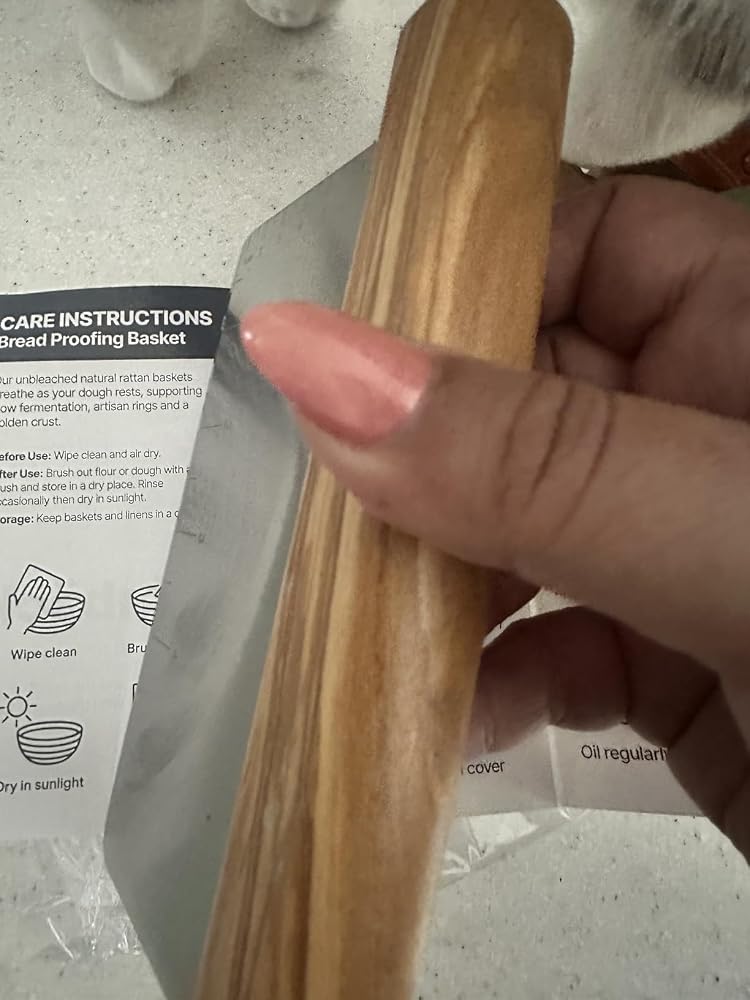
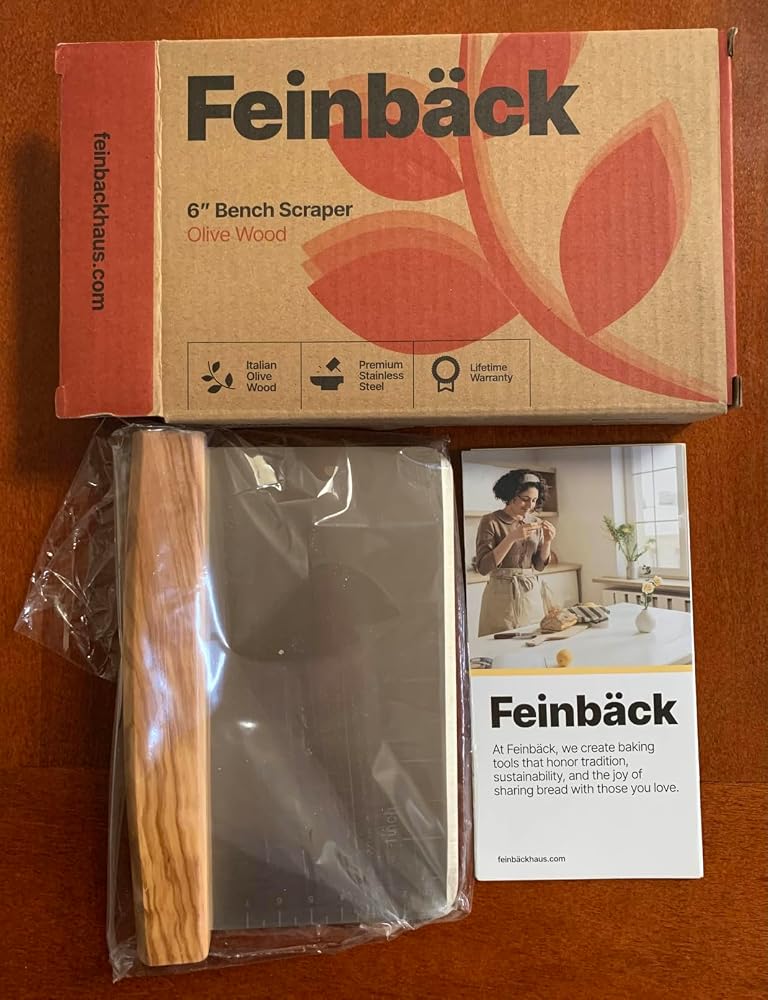
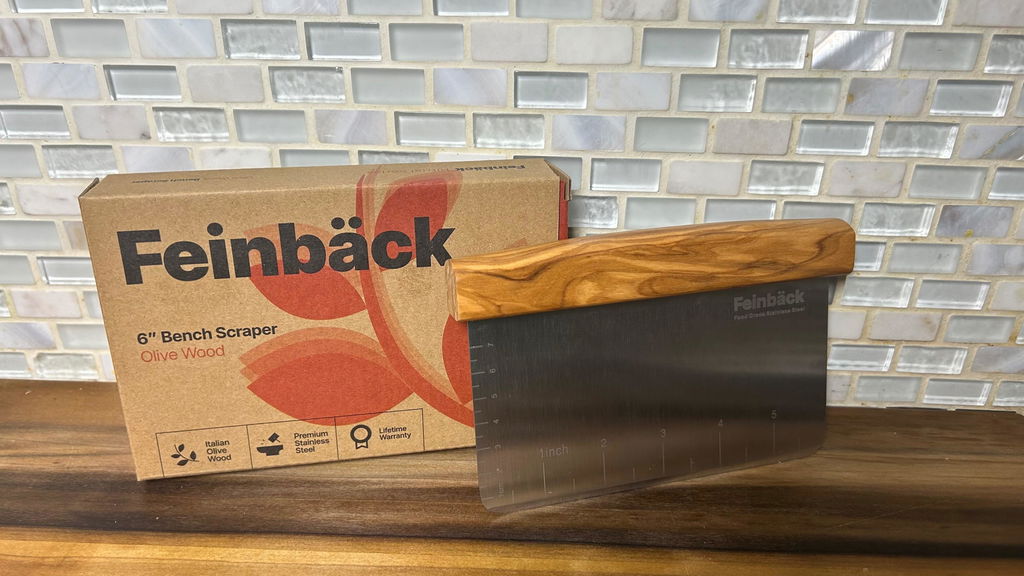
Overall, this is a very nice bench scraper. I have others that are more practical as kitchen tools, but if you want a touch of warmth and class of the olive wood handle, this scraper achieves that.Let's start with the handle, since it is the distinguishing feature from most other bench scrapers. It has a relatively simple, almost handmade aesthetic with simple lines. The top edge is comfortably shaped with a slight longitudinal curve along the top and rounded edges. Additionally, it is slightly longer than the blade, which provides both comfort for those with larger hands, but also more options for where to grip. The handle itself is a single piece of solid wood. It is not laminated. The blade sits in a kerf and is secured by a pair of rivets, which are set flush into the side surface of the handle. Interestingly, they are not full-depth rivets, as they are visible on only one side. The manual indicates that it should be HAND-WASHED and that you should occasionally apply oil to the handle. Honestly, the idea of applying oil doesn't seem like the best idea, though, because as far as I can tell, there is some sort of clear finish on the wood. I don't see how oil would have an opportunity to soak in. It's possible that the finish is a hard wax and not lacquer or shellac, but even the end grain is shiny. I would have preferred a more natural finish.The blade is a fairly thick stainless steel with a single bevel, inch markings lengthwise and centimeters for depth. The corners are both rounded. My favorite bench scraper has one rounded and one sharp corner, which is rather clever. On balance, I prefer these two rounded corners over two sharp corners. The bevel is sharp enough to use for basic portioning of dough, cutting butter, and the like. There is very little flex. There is an odd pair of tiny bumps in the back side of the blade at the corners. They're obvious in the right light and I was initially concerned that they might prevent the blade from actually scraping the bench, but it seems that they occur just at the start of the rounded portion.As for origin, it's not German, nor Scandinavian as the umlauted name suggests. It's made in China for a California-based company.For utility, I prefer a commercial grade vinyl- or plastic-handled scraper with more flex. A big advantage is being able to throw them in the dishwasher. Form over function with this model, but for many, that's absolutely fine and this scraper will be perfect for them.